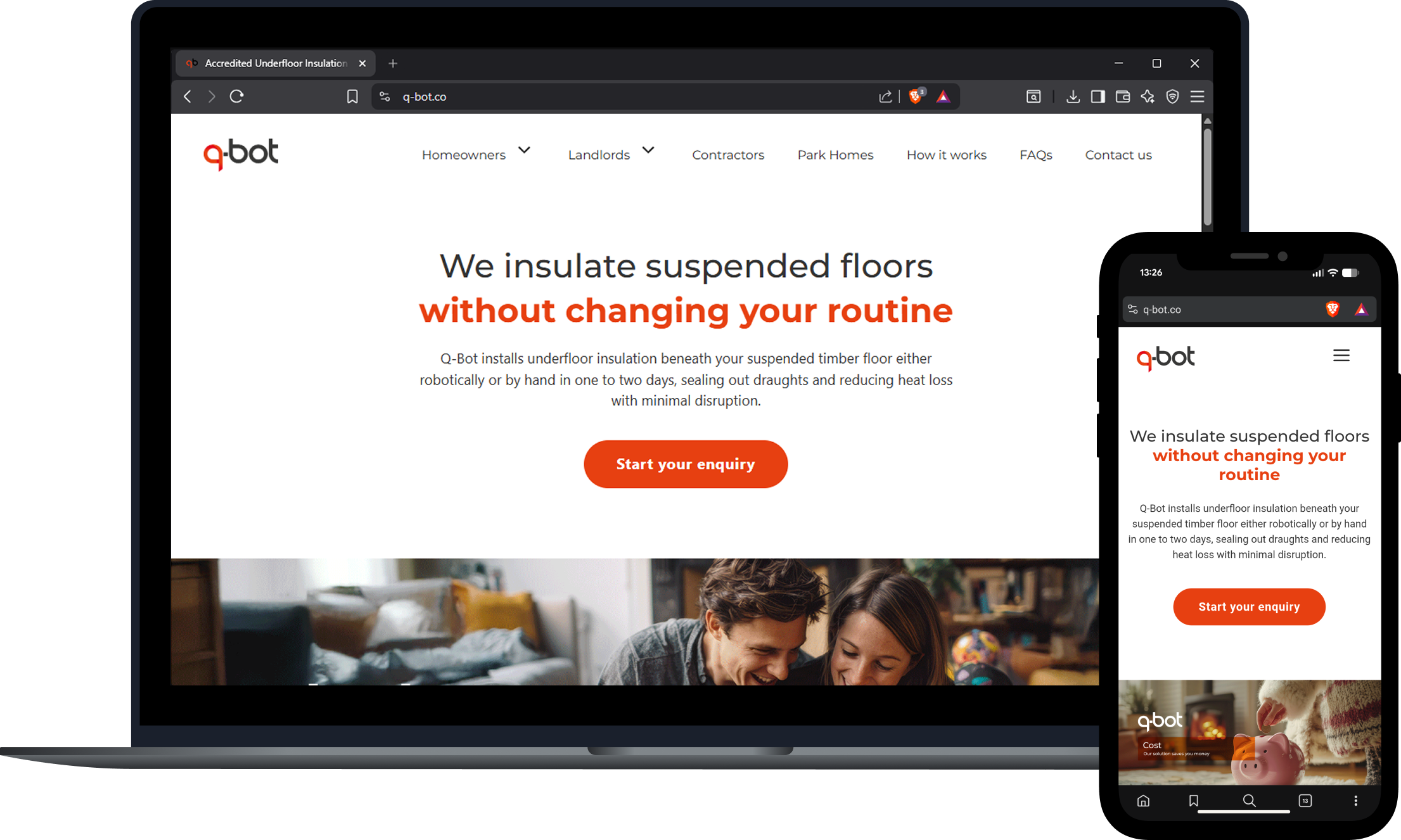
Restructuring Q-Bot's highest-entry page around what visitors already know, what they need to trust, and where they need to go next.
I owned the project end to end, from problem definition and hypothesis to redesign and implementation.
I used six months of analytics to identify the opportunity, worked through the hypothesis with stakeholders, and defined the measurement approach before launch.
Q-Bot is a UK company that provides accredited underfloor insulation, applied from below the floor using a robot. It serves several segments, including owner-occupiers, landlords, social housing providers and contractors, within a regulated retrofit landscape (PAS 2035, ECO4, TrustMark).
The page had evolved primarily as an awareness and education experience. But the audience arriving on it was telling us something different.
The analytics showed that the majority of homepage visitors arrived through direct or branded search.
This suggested that many visitors already knew Q-Bot existed. Yet the page led with education rather than helping visitors quickly answer the questions they were more likely to have.
Visitors were engaging with the content and scrolling deeply, but fewer than one in five progressed to a key page.
Exact visitor volumes and detailed funnel figures are confidential and omitted.
Hypothesis: Visitors likely already know Q-Bot and are looking for proof, process clarity and next steps, but are not finding them quickly or clearly enough.
I prioritised relevance, evidence and progression.
Note: I separated what the data showed from what I was inferring. Branded traffic indicated awareness, but it didn't prove purchase intent.
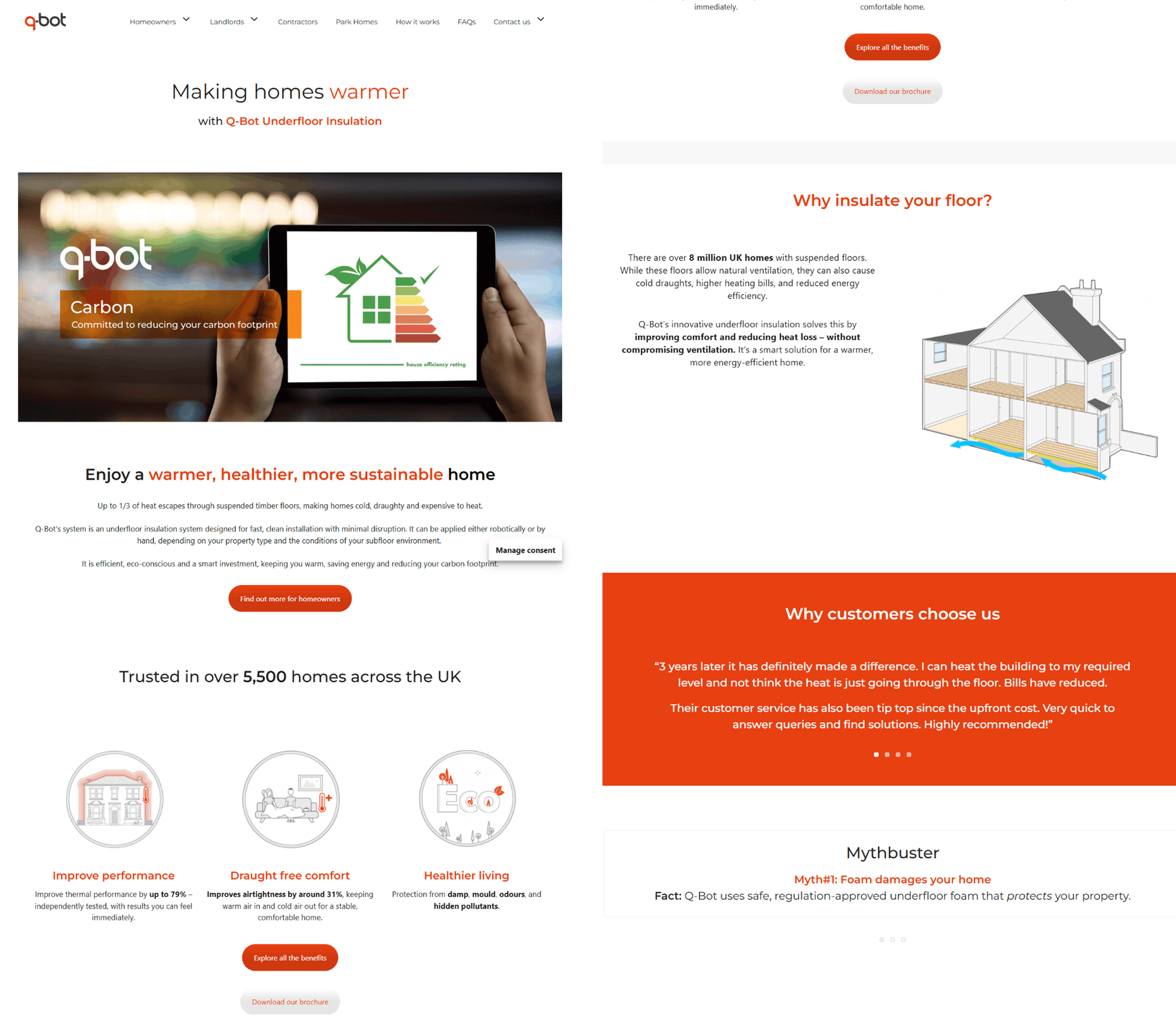
Key initiatives included:
The primary metric was defined before launch: Homepage → key-page progression.
The baseline was 17.8%, with a target of 24%.
I isolated the content demotion as a separately measurable and reversible change. This allowed us to learn whether reducing the prominence of educational content affected engagement without conflating that result with the broader homepage redesign.
A key part of the decision-making was recognising what the homepage could and couldn't solve.
I chose not to:
Despite the technical challenges, I worked within the existing WordPress/WPBakery setup rather than using the redesign as an opportunity to rebuild the underlying system. The priority was testing the product hypothesis and improving the customer journey quickly.
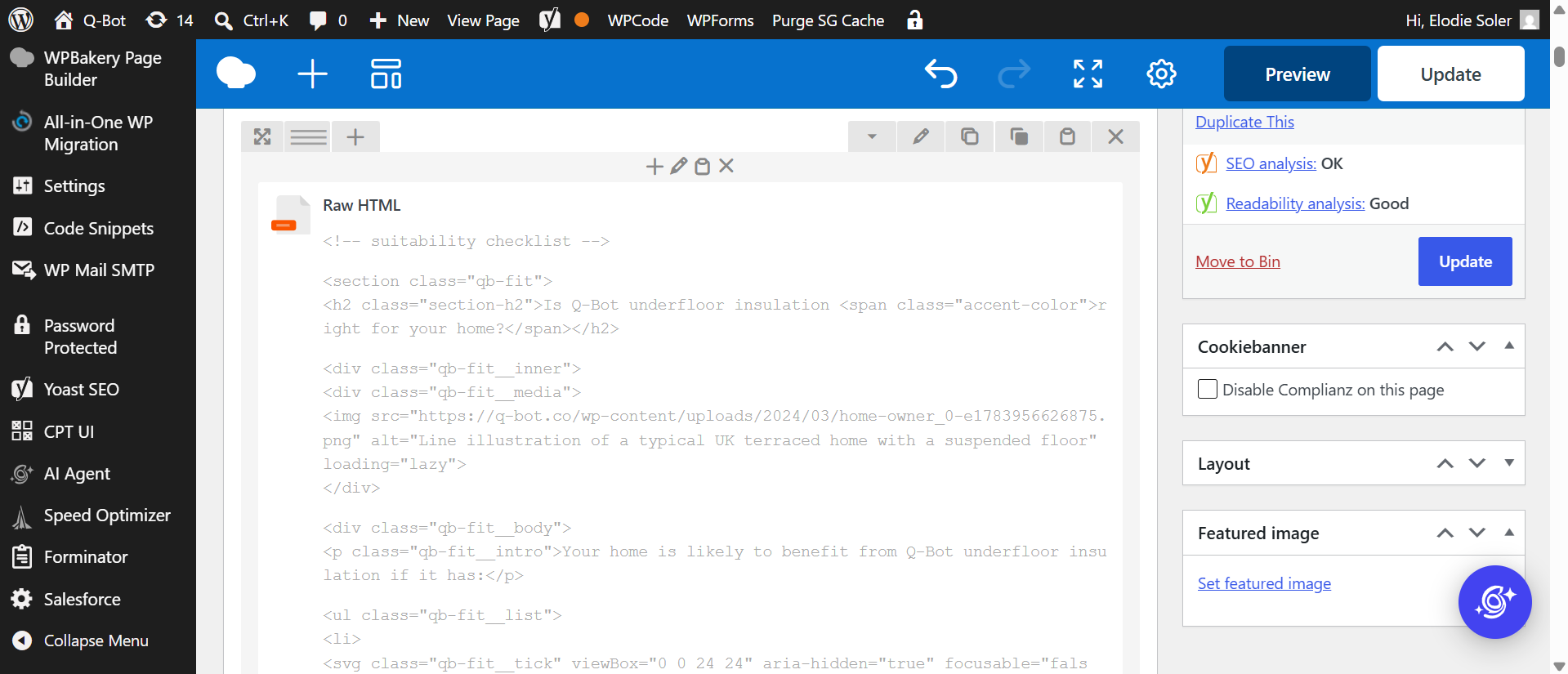
The redesigned homepage launched on 15 July 2026. The experiment is being measured against the pre-registered target of increasing homepage to key-page progression from 17.8% to 24%.
For the user:
For the business:
It also introduced a more disciplined approach to website optimisation: define the problem from behavioural evidence, make the smallest credible product change, pre-register how success will be judged, and separate what the experiment can prove from what it cannot.
The next decision will be whether to retain, iterate or roll back the changes based on their measured impact.
Next project →I'm currently building side projects and am always happy to discuss or get involved in problem-solving challenges. Have something in mind? Get in touch.
Email me